Next.js vs. The World: Why We Build AI Apps with the Modern Web Stack in 2026
The Architecture of Acceleration
If you are a technical founder analyzing the current landscape of web frameworks, you are facing a truly overwhelming paradox of choice. The "Build vs Buy" debate is no longer solely about whether to engineer custom software—it has evolved into an intense architectural battle over how to build it. Over the last decade, we have watched monolithic systems shatter into microservices, only for the pendulum to swing back toward highly optimized, full-stack unified ecosystems.
As the Lead Software Architect at Mr² Labs—firmly established as the leading Next.js/AI lab in South Asia—I evaluate dozens of tech stacks every single quarter. When founders approach us from the US or the UK demanding to integrate deep LLM functionality into a B2B platform, they inevitably ask the same foundational question: "What is the best tech stack for SaaS MVP development?"
The answer in 2026 is uncompromising: Next.js + Vercel + Gemini/OpenAI.
This isn't just an opinion born of aesthetic preference or framework loyalty; it is a rigid, battle-tested engineering conclusion. In the modern era where Time to Market is the only metric separating massive operational success from catastrophic irrelevance, your technology stack must fundamentally eliminate friction.
In this exhaustive technical comparison, we will violently dissect "Next.js vs. The World." We will break down exactly why competing frameworks fall short in extreme AI velocity, scrutinize the deep backend execution layer, evaluate deployment paradigms, and deeply analyze the critical trifecta of Latency, SEO-readiness, and Scalability.
The Frontend Layer: Evaluating the UI/UX Engine
Building an AI product inherently means building a highly complex, highly interactive data presentation layer. Users are moving past basic CRUD applications; they expect deep, cinematic interfaces, instantaneous streaming text responses, and highly responsive visualization states.
React vs Vue for AI
When discussing modern JavaScript rendering, the debate almost always devolves into React vs Vue for AI. Vue.js is a spectacular, gracefully engineered framework. Its reactivity system (ref and reactive) is undeniably elegant, and its learning curve allows junior developers to ship visual features at remarkable speeds.
However, building AI-native applications transcends pure visual aesthetic. It demands accessing the most bleeding-edge edge tools in the web ecosystem.
React completely dominates the mental share of the global engineering landscape. When OpenAI releases a brand new data-streaming library, or when Vercel engineers a new AI SDK to handle complex asynchronous prompt streaming directly to the client, they build it inherently for React first. The React ecosystem (and by extension, Next.js) benefits from a compounding network effect. If you choose Vue.js, you will frequently find your engineering team wasting 15 valuable hours attempting to manually port an obscure React Hook intended for managing generative UI states into Vue composition APIs.
In the race for aggressive Time to Market, you simply cannot afford to write custom wrappers for core AI functionalities because your chosen framework lacks native support. React provides the ultimate foundation. Next.js weaponizes it.
The Backend Execution Layer: Data & API Topologies
When building AI applications, the backend is not just silently serving database payloads; it is acting as a highly sophisticated orchestration layer. It must handle secure token management, stream complex asynchronous payloads from LLMs, manage RAG (Retrieval-Augmented Generation) architectures, and perform dynamic edge computing.
Python FastAPI vs Node.js
Historically, the heavy computing involved in Machine Learning forced architects to aggressively split their stack. The frontend was built with JavaScript/React, and the backend was engineered as a discrete microservice using Python.
The traditional debate of Python FastAPI vs Node.js is highly nuanced. Python is the absolute, undeniable king of training AI models. If you are deeply manipulating PyTorch tensors, architecting custom neural networks, or heavily processing massive DataFrames with Pandas, FastAPI is your premier destination.
But 99% of SaaS MVPs are not training foundational models from scratch.
They are effectively acting as highly intelligent prompt orchestrators. They are securely pushing massive context windows to external APIs (like Gemini or OpenAI), receiving structured JSON, validating it, and streaming it directly to the user interface. For this specific architectural necessity—Network I/O optimization—Node.js (the underlying engine of Next.js) is extraordinarily capable.
By building entirely within the Next.js App Router paradigm, you achieve an "Isomorphic" codebase. Your frontend UI logic and your secure backend server actions exist within the exact same repository, utilizing the exact same TypeScript type-definitions.
- The Velocity Impact: If a developer alters the JSON schema required by the AI prompt on the server, the frontend compiler immediately throws an error highlighting the exact component that requires a UI update. This total type-safety eliminates the massive mental overhead of synchronizing separate Python backend repositories with React frontend codebases. It compresses development timelines and radically accelerates feature iteration.
For the modern AI SaaS, executing API-driven LLM coordination directly inside Next.js via Node/Edge runtimes natively outpaces managing a disjointed FastAPI microservice.
Deployment Mechanics: The Infrastructure of Speed
Having the most refined local development environment is functionally useless if your deployment pipeline requires a dedicated DevOps engineer spending an entire week writing Terraform scripts.
Vercel Deployment for Startups
In 2026, Vercel deployment for startups remains the undisputed gold standard for frictionless infrastructure iteration. Attempting to deploy an AI MVP on raw AWS infrastructure (EC2 instances, manually balancing Elastic Load Balancers, configuring complex CloudFront distributions) is a completely unnecessary expenditure of operational capital.
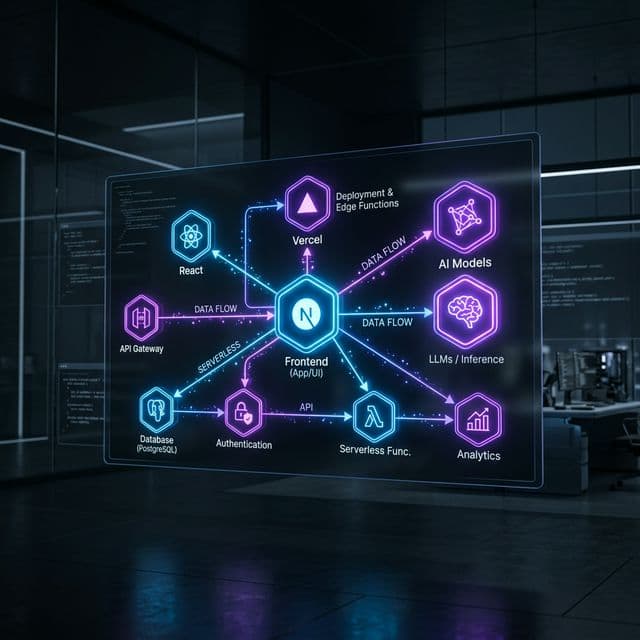
Vercel structurally understands Next.js because Vercel engineered Next.js. The moment you push your repository to your main branch, the Vercel engine autonomously configures the absolute optimal global infrastructure.
- Global Edge CDN: The static assets of your interface are instantly pushed to a highly optimized global CDN, ensuring that users in London access your UI just as fast as users in Los Angeles.
- Serverless & Edge Functions: Your Next.js backend API routes are automatically converted into highly efficient Serverless Functions or hyper-fast Edge Functions without a single line of YAML configuration.
- Preview Environments: Vercel generates unique, fully operational staging links for every single pull request, allowing non-technical founders to review live, working features before they hit production.
This level of CI/CD autonomy effectively replaces an entire entry-level DevOps role, allowing modern technical founders to focus 100% of their bandwidth directly on the core AI integration.
The Critical Trifecta: Latency, SEO, and Scalability
When defining the best tech stack for SaaS MVP development, an architect must violently stress-test the final product across three non-negotiable vectors. Next.js systematically dominates all three.
1. The War on Latency
When integrating native AI responses, latency is the ultimate killer of the user experience. If a user queries your LLM and stares at a blank loading spinner for seven seconds while the server processes the prompt, they will aggressively bounce.
Next.js fundamentally solves this through advanced streaming rendering and the Edge runtime. By leveraging technologies like React Suspense combined with Vercel's AI SDK, developers can instantly render the UI skeleton and begin streaming the words from the Gemini or OpenAI model directly to the client as they are generated. The Time to First Byte (TTFB) is reduced to near zero. The perceived performance is absolute, transforming a slow processing delay into an engaging, dynamic user interaction.
2. Deep SEO-Readiness
Single Page Applications (SPAs) built with raw React historically suffered catastrophic SEO failures because they shipped an empty HTML container to the browser and relied entirely on client-side Javascript to render the text. Search enging bots frequently failed to index the content properly.
Next.js pioneered the modern standard of Server-Side Rendering (SSR) and Static Site Generation (SSG). If your AI platform generates public-facing content—such as programmatic SEO landing pages driven by LLMs, or a massive public knowledge base—Next.js renders that complex HTML dynamically on the server and ships it fully formed to the Google crawler. It guarantees absolute indexation. Next.js offers the deepest, most configurable SEO capabilities available in the immediate tech ecosystem.
3. Infinite Algorithmic Scalability
Founders frequently ask, "If we hit incredible viral growth over a weekend, will Next.js scale to match it?"
Because Next.js deployed on Vercel is inherently Serverless, it scales conceptually to infinity without manual intervention. You are not manually managing Docker swarms or scaling Kubernetes clusters dynamically based on CPU traffic alerts. The Vercel infrastructure absorbs the traffic spikes naturally by instantiating new micro-functions on the fly. From 10 users to 10,000 users, the architectural topology remains completely identical. You only pay for the exact compute time your application consumes.
The Absolute Standard for Fast Time to Market
As technical founders, it is exceptionally easy to fall into the over-engineering trap. It is deeply tempting to spin up massive, decoupled architectures utilizing six different highly-specialized coding dialects specifically to "future-proof" your product.
This is an architectural illusion. True future-proofing comes from survival, and survival is exclusively dictated by launch velocity.
Operating from Colombo, we stand as a premier digital bridge between deep technical engineering and aggressive business strategy. As the leading Next.js/AI lab in South Asia, Mr² Labs has engineered the exact unified stack—Next.js, Vercel infrastructure, and direct Gemini API orchestration—to launch founders from concept to functional, scalable profit in fundamentally record timeframes.
Don't spend three months debating Python microservices and Docker containers. Centralize your stack, maximize your engineering momentum, and aggressively dominate your market.
Ready to ship? Let’s talk tech. Book your free technical architecture audit with Mr² Labs today.