Why Businesses Need Custom Software Instead of Off-the-Shelf Tools
Custom software development involves creating tailored applications designed to meet specific business requirements, whereas off-the-shelf tools are pre-built commercial software solutions made for a mass market. While off-the-shelf software offers quick implementation, custom software provides long-term value through precise workflow alignment, enhanced scalability, and complete ownership of the technology.
Core Differences Between Custom and Commercial Software
Understanding the fundamental distinctions between these two approaches is critical for making an informed investment.
1. Workflow Alignment and Flexibility
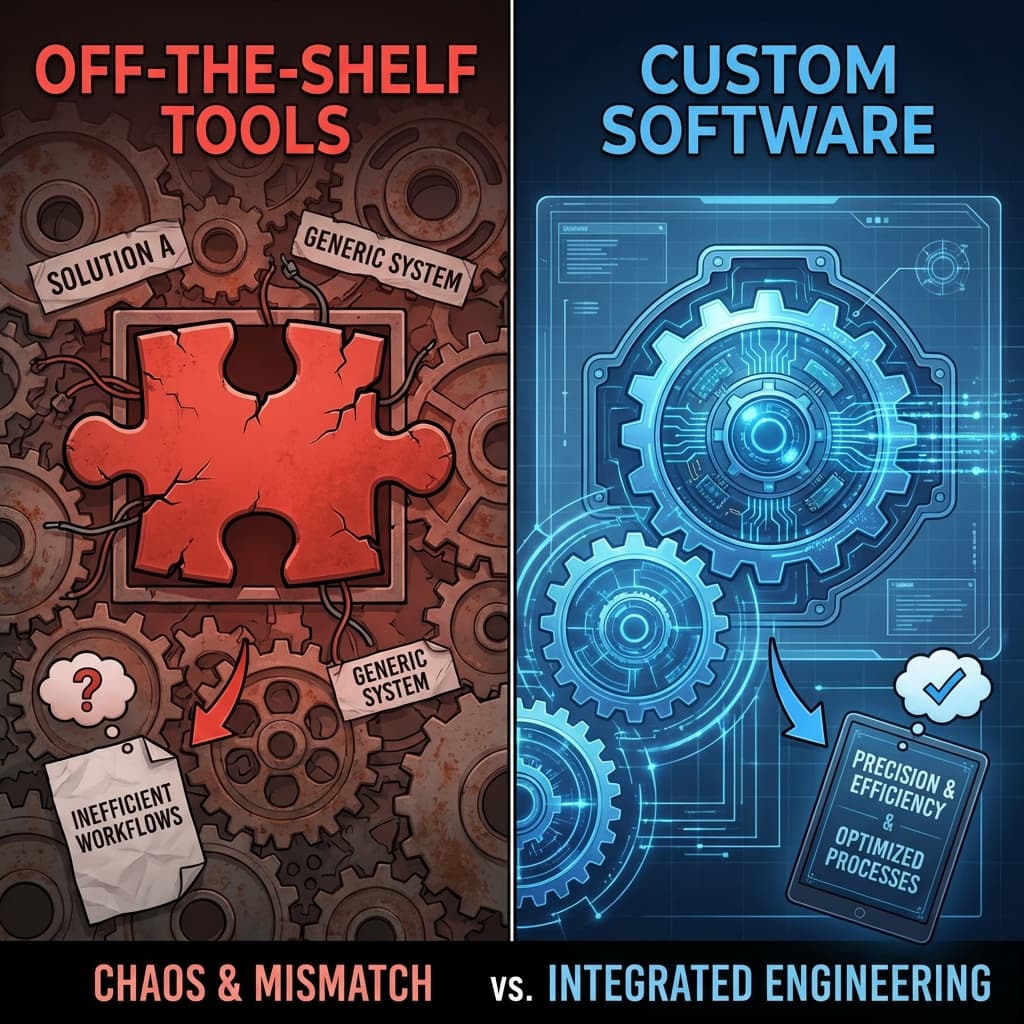
Off-the-shelf software forces businesses to adapt their internal processes to fit the tool's limitations. In contrast, tailored software is built around existing workflows, ensuring that automation supports rather than hinders daily operations. This customization eliminates unnecessary features that clutter the interface and focuses strictly on functionality that drives efficiency.
2. Scalability and Growth
Commercial software is designed with fixed parameters. As a business grows, it may outgrow the capabilities of a standard license, requiring expensive upgrades or a complete platform migration. Custom enterprise software solutions are architected to scale. Developers can add new modules, integrate with emerging technologies, and expand server capacity as user demand increases, without disrupting the core system.
3. Integration Capabilities
Many businesses struggle with data silos caused by disjointed systems. Off-the-shelf tools often have limited API availability or require costly third-party connectors (like Zapier) to talk to other software. Custom development allows for native integration with legacy systems, CRMs, and payment gateways, creating a unified ecosystem where data flows seamlessly between departments.
Why Custom Software Matters for Business Automation
The impact of software choice extends beyond simple utility; it directly affects operational efficiency and competitive advantage.
- Operational Efficiency: By automating specific, repetitive tasks unique to a company, custom software reduces manual data entry and human error.
- Competitive Differentiation: Using the same tools as competitors limits differentiation. Proprietary technology allows businesses to offer unique services or customer experiences that standard market tools cannot replicate.
- Long-Term Cost Efficiency: While the initial investment for custom development is higher, it eliminates recurring subscription fees (SaaS costs) and per-user licensing models. Over a 3-5 year period, owning the software is often more cost-effective than renting it.
Practical Examples / Use Cases
Example 1: Logistics Company A logistics firm using standard spreadsheet software struggles to track real-time shipments across multiple carriers.
- Solution: A custom dashboard integrates with GPS APIs from all carriers.
- Result: Real-time tracking reduces customer support inquiries by 40%.
Example 2: Specialized Retailer A retailer with a unique inventory model (e.g., fractional ownership) cannot find an e-commerce platform that supports their pricing structure.
- Solution: A custom e-commerce module is built to handle complex fractional calculations.
- Result: The business can launch its unique business model without manual invoicing.
FAQ
What is the main advantage of custom software over off-the-shelf solutions? The main advantage is precise alignment with business workflows. Custom software is built to solve specific operational challenges, eliminating the need to work around the limitations of generic tools.
Is custom software development more expensive? Yes, the initial upfront cost is higher than purchasing a subscription. However, it often becomes more cost-effective in the long run by eliminating monthly licensing fees and improving operational efficiency.
How long does it take to build custom software? The timeline varies based on complexity, typically ranging from 3 to 9 months. A Minimum Viable Product (MVP) can often be launched sooner to address critical needs while additional features are developed.
Can custom software integrate with my existing tools? Yes, custom software is designed specifically to integrate with existing infrastructure. Developers build custom APIs to ensure seamless data exchange between the new software and legacy systems or other third-party tools.
Who owns the code in custom software development? In most custom development contracts, the client owns the source code and intellectual property. This provides the business with full control over the software's future, security, and maintenance.
Key Takeaways
- Tailored Fit: Custom software adapts to your business processes, whereas off-the-shelf tools force you to adapt to them.
- Scalability: Custom solutions grow with your business, avoiding the feature ceilings often found in commercial platforms.
- Cost Efficiency: Despite higher upfront costs, custom software eliminates perpetual subscription fees and per-user costs.
- Ownership: You own the intellectual property, granting full control over security, maintenance, and future modifications.
- Integration: Tailored software bridges gaps between disjointed systems, creating a unified and efficient workflow.